Monday, 14 September 2009

Dorian Gray (plus Q&A), BFI

Apart from the essentials of the premise (which just about everyone must know anyway, irrespective of whether they’ve read the book), the main thing I can remember from The Portrait of Dorian Gray is learning that I could thumb forward a few pages as soon as I saw a paragraph-long description of some flowers.

So, maybe I’m not the best person to judge how successful an adaptation Dorian Gray is. Or maybe I am, because I’m not so smitten and possessive about the original. It was clear from the film and the following Q&A that the filmmakers – particularly absent screenwriter Tom Finlay – aimed to keep a similar distance from the source material.

Indeed director Oliver Parker said that they brought in Finlay because his vision for the film lacked some of the literary reverence that restricted earlier drafts. Talking about adaptations more generally, Parker argued that sometimes you need to move some distance from the source material to gain a better perspective on the original.

After his previous adaptations of Wilde’s stage plays An Ideal Husband and The Importance of Being Earnest, Parker felt that an adaptation of the author’s novel could offer something more cinematic that those two films, which he feels remain performance pieces at their core (even though he was attempting to “blow the dust off Wilde”).

Their aim with the script wasn’t just to animate the novel as it was written, but to approach the story as they thought Wilde might have if he was alive today and – as he almost certainly would have been – writing scripts.

Parker admitted there’s a trade-off in adapting such literary work. On the one hand, you inevitably lose some of the narrative’s mystique; whoever plays Dorian Gray is never going to be as mysteriously beautiful as the literary character, while the grotesque portrait always takes on a more hideous aspect in the reader’s imagination than might be depicted on screen.

However, giving the world of the book physical form also provides positives for the narrative. Dorian becomes more of a character than the enigmatic cypher of the book. We also become able to see things through his eyes; Parker thought this might be partly why they entitled the film just Dorian Gray, rather than following the book’s lead.

The question inevitably arose of why they didn’t set the film in a more modern context, especially given the current obsession with youth, beauty, celebrity etc. Parker responded by pointing out that the repression in Victorian society is a key engine of the story; it’s what makes Dorian’s licence to do what he wants even more powerful.

He added that the social conditions of the time also made for a stronger contrast between the well-heeled social circle of Wotton and Gray and the grime of the Whitechapel demi-monde into which the Mephistophelean Wotton initiates Gray.

Finally, he said that he prefers the metaphor of using Wilde’s work in its original setting to depict something about the present day. Wilde was ahead of his day - and maybe still is – and period films work better when they have a strong perspective on the present.

In technical terms, Dorian Gray is a strongly coherent film, with a clearly defined structure and a consistent tone. Parker’s earlier work included theatrical collaborations with horror writer Clive Barker, and the film touches effectively on the Gothic atmosphere of its source while adding a contemporary visceral edge.

The script is also admirably sparse, resisting the temptation to slap on layer upon layer of characteristically ‘Wildean’ dialogue or narration. Colin Firth spits out a few familiar epithets as the sardonic Wotton, but the story is generally told with slick cinematic economy.

Edit: Here's a note from Fun Joel on his response to the script when he read it for a Hollywood studio.

Friday, 11 September 2009

The Black Album, National Theatre

Hanif Kureishi's dramatisation of The Black Album at the National Theatre hasn't been well received by critics in comparison with the 1995 novel on which it's based - and I can see where the gaps probably fall (although I haven't read the book yet).

The play tells the story of Shahid, a British-Asian teenager who moves from sleepy Sevenoaks to London in 1989, just as the ecstasy-fuelled rave culture is reaching its zenith. The naive student is soon groomed by a group of Muslim fundamentalists, and feels empowered by the sense of belonging they give him.

However, his love of pop culture - particularly the music of Prince, from whose album the work takes its name - also leads him into the arms of Deedee Osgood, a hedonistic liberal lecturer. Shahid's criminally entreprenurial brother Chili turns up as well, urging him to go out and take what London has to offer.

I have a bit of a weird relationship with Hanif Kureishi's work. I think he's a fascinating commentator on London life, but I tend to enjoy the idea of his dramatic work more than the finished 'product'.

I find his stylised dialogue a bit 'stagey', and it can make his characters seem slightly unrealistic or unconvincing - a problem when his characters are in a very recognisable time and place where a more naturalistic approach might fit better.

Even allowing for the tone of fundamentalist rhetoric, I found myself pulled out of the drama on a few occasions, thinking that people just don't speak like that. Maybe it wasn't helped by some slightly unsubtle performances: Shahid's brother Chili came over more like Boycey from Only Fools and Horses than a young British-Asian man.

It also seemed that Shahid's initial oscillation between the earthly pleasures of London life and the comforting certainty of religious immersion wasn't dramatised as effectively as it could have been. For all the power of drama, I guess that kind of internal psychological dialogue is better suited to the novel.

The claustrophobic set on the tiny Cottesloe stage didn't help, either. Even with emphatic video projections and music, we didn't get much sense of the teeming city into which Shahid had been flung.

Anyway, the more plot-based second half was more satisfying, as the anger over the publication of The Satanic Verses reached boiling point and the characters had to choose where they stood on the complex spectrum of free speech vs censorship.

It was an enjoyable evening, and the issues of cultural identity and radicalisation tackled by the book are clearly as relevant now as they were on publication (the slightly confusing dumbshow that ends the play seems to draw a link between its events and the 7 July bombings). I'll definitely give the book a go.

BBC: rehearsal video and interview with Hanif Kureishi
The Times: interview with Kureishi and director Jatinda Verma
Huffington Post: Hanif Kureishi on the couch
National Theatre: includes video trailer, production gallery

Wednesday, 9 September 2009

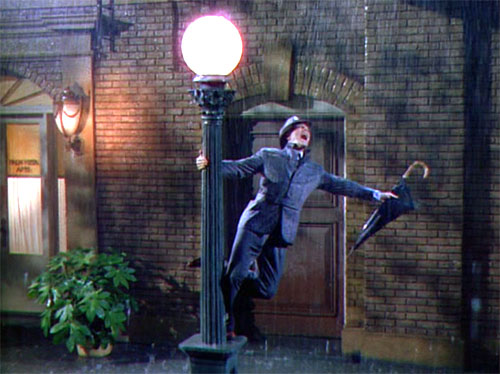
Singin' in the Rain, BFI


The BFI screening of Singin' in the Rain the other night had an unexpected bonus: director Terence Davies (Distant Voices, Still Lives) gave a brief intoduction to the film, having selected it as part of a series shown in collaboration with the National Film and TV School.

With charm and enthusiasm, he revealed it was the first film he ever went to see, and that he still loves it so much he finds it difficult to talk about it without becoming emotional.

When you think of Singin' in the Rain, the screenplay probably isn't the first thing that comes to mind. However, a quick look at the origin of the film reveals a couple of useful lessons about making the most of unpromising source material and using 'creative limitations' to help you make the right choices.

In 1950, producer and songwriter Arthur Freed hired Betty Comden and Adolph Green to write a screenplay that would showcase a number of songs from the 20s and 30s to which he owned the rights.

However, having to accomodate what were already fairly outdated songs wasn't the only problem they faced. They had to come up with a spectacular set-piece conclusion to match that of Gene Kelly's previous film, An American in Paris, and work round the fact that Debbie Reynolds, the rising starlet foisted upon the film by MGM, wasn't a very experienced dancer.

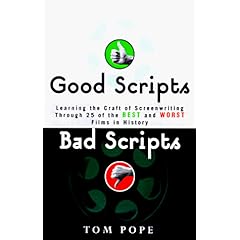
However, Thomas Pope, in his analysis of the film in Good Scripts, Bad Scripts, summarised the way in which the writers turned the situation around:
"The limitations imposed upon Comden and Green were problems that liberated the writers from easy choices and forced decisions upon them that made for a more complex and sophisticated film."
By setting the film at the time the songs were written, they were able to craft a story about the moment the film industry made its difficult transition from silent films to the 'talkies'.

Meanwhile, they got around Reynolds' inexperience by introducing a more capable dancing partner for Gene Kelly; they created the role of Cosmo (Donald O'Connor), a best friend who could match Kelly's athleticism.

Neil Gaiman made a similar point about 'creative limitations' at the Edinburgh Book Festival last month, saying that if you're commissioned to write an eight-page horror story set in a public toilet in Sheffield, it's easier than being given a total carte blanche.

It may be a bit counterintuitive, but it seems that constraints and boundaries tend to inspire creativity rather than inhibit it. I guess if you're having trouble staring at the blank page, come up with a few parameters of your own to focus your imagination.

(Pope also provides a more detailed analysis of the script's structure, particularly how the first act of Singin' in the Rain continually introduces new problems or amplifies a problem that had already been introduced.)

PS. While talking about the choices Comden and Green made, Pope makes another more general observation that I can't resist quoting:
"There are damned few ideas that can't sound good after a few hours of being trapped in a room, trying to come up with a story. The very act of collaborative creation is a desperate, often atavistic fight, where the muse tries to make the writer choose bad ideas and his only defence is his professional shit detector."
Analysis/detailed summary of Singin' in the Rain (Filmsite)

Tuesday, 8 September 2009

Blue Murder, ITV1

Here's a quick review I wrote last night for Orange. From a screenwriting point-of-view, I don't have much to add; the main story might have had a little bit too much plot, although the final result fitted nicely and had an emotional impact.

However, I didn't find it plausible that the husband wouldn't ring the police when he found his wife's battered body in the garage, in case it looked a bit suspicious. The domestic subplot involving the son also didn't add much and seemed a bit tacked on (although I think the balance between Janine's work and home life is a key element of the series).


Blue Murder, starring Caroline Quentin as empathetic copper DCI Janine Lewis, the head of a murder investigation team on the mean streets of Manchester, is now back for its fifth series. I'd never watched it before, but it's obviously doing something right.

The first episode explodes onto the screen from the cut-throat world of competitive cheerleading. When team coach Helen Gaskell (Carolyn Backhouse) gets her head clubbed in with a clawhammer the morning after her team fail to qualify for the national championships, suspicion immediately falls on her niece Jess (Holliday Grainger), who was dropped from the team in favour of Helen's daughter Melanie.

However, it doesn't take long for Alan, Helen's husband, to become the prime suspect. In fact, our suspicions are raised the minute we see he's being played by notorious Weatherfield wrong 'un Peter Barlow (Chris Gascoyne). Things go from bad to worse for Alan when the detectives find some of his blood-smeared clothing on a nearby building site and discover that he knew his wife was having an affair.

But there's more to Blue Murder than blood-spattered garage floors and suburban infidelity. DCI Lewis is, of course, a Working-Mother-Who-Has-to-Juggle-it-All – especially since her ex-hubby jumped on an EasyJet to Spain at the end of the previous series. So, we have a tacked-on subplot involving planning a birthday party for her son, who has fallen out with his best mate at school and benefits from a man-to-man chat with Janine's trusty deputy DI Richard Mayne (Ian Kelsey, pictured above).

Some Tory fella the other week got a bit of attention by saying bits of the UK were like The Wire, comparing Manchester to Baltimore. Blue Murder doesn't quite live up to that billing. It doesn't try to be as grim, gritty or edgy, but it maintains a serious atmosphere, anchored by the presence of Caroline Quentin and tempered by the trademark cheeky banter of the rest of her team.

It's a well-plotted and convincing murder mystery that provides enough false trails and possible suspects to keep the audience guessing, but then pulls a last-minute swerve (rather than a twist) to deliver an emotionally satisfying ending. Despite the unnecessary diversions into Janine's domestic situation, Blue Murder is solid TV cop fare; it's easy to see why it's got to a fifth series.

Picture: ITV

Monday, 7 September 2009

Away We Go, BFI

Away We Go (out on Sep 18, I think) is a fairly traditional Indiewood road movie, along the lines of Little Miss Sunshine or Sideways, directed by Sam Mendes from a script by Dave Eggers and Vendela Vida.

When thirty-somethings Burt (John Krasinski) and Verona (Maya Rudolph) find out they're expecting a kid, they realise they need to move out of their ramshackle house and find a more functional home in which to bring up their child.

They set off on a road trip to visit various friends and relatives and try out their cities for size. So, they drop in on Verona's uninhibited ex-boss, a trust-fund hippy childhood friend of Bert, Verona's sister and a pair of married college friends, before being summoned to Miami to help Burt's brother deal with his wife walking out on him.

Each of the encounters highlights a different facet of parenthood and the relationship between generations, fitting in with the classic road movie template of the characters' psychological journey taking precedence over their physical travels.

The journey eventually leads to the couple renegotiating the terms of their relationship and Verona starting to come to terms with the death of her parents in her early 20s. The revelation of the final destination in which they choose to live gives the film a simple (and mostly wordless) but surprisingly moving conclusion.

It's a fairly slight film, and its structure - obviously - means that it's a bit episodic; each of the 'chapters' is given an emphatic title card. Some of the characters are also a bit over-the-top or clearly designed to illustrate a point, but then the structure means that they don't outstay their welcome.

Away We Go isn't innovative or life-changing, but its leads give charming performances and it can sit alongside films like Broken Flowers, Transamerica and the two mentioned above as a worthwhile modern addition to the transformational road movie.

Interview with Eggers and Vida (Film in Focus)

Two-part essay on road movies by Sam North (hackwriters.com)

Friday, 4 September 2009

(500) Days of Summer plus Q&A, Barbican

NB: review contains spoilers

Last night we saw a preview of (500) Days of Summer at the Barbican, followed by a quick Q&A with director Marc Webb and co-writer Scott Neustadter. The film has been billed as a "post-modern rom-com"; greetings card writer and frustrated would-be architect Tom (Joseph Gordon-Levitt) falls for his boss's new assistant Summer (Zooey Deschanel), and we trace their relationship over the 500 days of the title.

However, while Tom throws himself whole-heartedly into the relationship, Summer remains a little aloof and unattainable, never quite committing fully. Their split is revealed early in the film, and rather than ending with them getting back together again, the 'happy ending' is Tom realising that had he put too much weight on their relationship and that he needs to look forward instead of back.

In terms of screenwriting techniques, the film is interesting in that it tosses naturalism out the window and uses a variety of narrative tricks to enliven the story. The most obvious of these is the non-linear structure. Using an onscreen ticker to identify which of the 500 days we're currently on, the film starts after the couple have split up, and then flips back and forth to show how their relationship developed and how Tom deals with its aftermath.

It also uses a Pushing Daisies-style narrator. The device is used sparingly, but once or twice it comes across as a slightly clumsy way of articulating what's going on in the characters' heads.

Other narrative flourishes include a split-screen comparison between Tom's expectations and the reality of a party he attends, and a musical sequence that depicts Tom's joyous state of mind the morning after he and Summer finally consumate their relationship.

However, the tone, style and structure are well established in the pre-title sequence, drawing the audience into the film's world so that the subsequent flights of narrative fancy don't come as a nasty shock.

The relationship between naturalism (still the predominant dramatic mode in the UK) and more overtly cinematic techniques is something that I think I've banged on about before. I generally love it when films draw attention to their artificial nature (Amelie and Annie Hall are examples that springs to mind), but as both a viewer and a writer it still feels a bit like a guilty pleasure - like it's somehow cheating to use narrative 'gimmicks'.

Anyway, that sounds like quite a dry dissection of what is a very enjoyable film. It might not quite be the new Annie Hall, as some slightly over-enthusiastic commentators have suggested, but it's a very engaging look at that time in your life when your first big relationship picks you up and gives you a good shake.

The Q&A after the screening was well led by film journo Charles Gant. Scott Neustadter said that the script was based on a relationship he had while living in London, and was initially an act of catharsis. However, the input of his co-writer Michael H Weber enabled him to gain a bit of objectivity on the material and convert his angry first draft into something more accessible and universal.

The writers were keen to draw attention to the gap between mainstream Matthew McConaughey-style rom-coms and the reality of how relationships actually tend to work. They also wanted to move beyond the stereotypes of how men are generally represented as emotionally illiterate in stuff like Judd Apartow's films.

In fact, they expressed a bit of surprise that the film is being marketed as a rom-com at all. They view it more as a coming-of-age story than a clash of the genders, as Tom moves from his initially idealistic view of Summer to a more mature appreciation of how relationships work.

Referring to the non-linear structure, they said that's how you tend to remember love affairs - your memory draws links between various episodes, such as trips to a particular location that took place under different circumstances. They spent a lot of time in development justifying each of the time-shifts in the script (although it becomes much more linear during the second half).

Following that structure allows the audience to analyse the relationship in the same way that Tom does, while also depicting how his perceptions and the way he remembers the relationship also changes, marking his growth from anger at their break-up to acceptance.

Interview with writers Scott Neustadter and Michael H Weber (HitFix)
Another interview with SN and MHW (CanMag)
Interview with director Marc Webb (Cinematical)
First draft screenplay (via Script Collector)

Friday, 14 August 2009

525,600 minutes of mantra-filled oompah


Well, inspired by Jez Friedman I just happened to glance earlier today at when I published my first post - and guess what?! It was a year ago to the day. So, I thought I'd better take a few moments off packing for a week's trip to the Edinburgh fringe to mark the occasion.

This time last year I'd just finished my MA at Bournemouth, and I have to admit that I haven't made quite as much progress with my screenwriting career as I would have wished. I took redundancy last August, so I've been establishing myself as a freelance writer and editor since, which has meant occasionally taking on too much work to allow for adequate screenwriting activity.

However, despite not promoting myself a great deal, I have been working on a couple of chunky projects that are quite a way ahead of anything I did before my MA (pilot script for drama series and new feature-length script), so there should be promising fruit from those particular shrubs within the next few months. I'm also waiting to hear back from a couple of agents who requested my main MA script after I sent out a few query letters.

I also (finally) picked up a copy of Adrian Mead's book How to Make it as a Screenwriter * this week, and was pleased to find that I'm already on the right road with some of the strategies he suggests for getting up that slippery ladder.

When we get back from Edinburgh I'm going to start knitting things together into a cohesive approach - including revisiting the stuff I wrote before doing my MA. I'd pretty much written it off, but some of it got quite a good reception, so hopefully I'll be able to attach the jump leads to its pink bits and give it a new lease of life.

So, that's Year One out of the way. I guess that trying to maintain the blog occasionally ate up time that could have been better used on more directly writing-related activity, but it's also encouraged me to try and form critical opinions more quickly about stuff I've seen.

Thanks to anyone who's commented or emailed over the past 12 months. My Year Two resolution - not to sound like such a tedious old stoat in my blog posts.

* If you haven't already bought and downloaded Adrian's book, you really should. It's a detailed and direct guide to what you need to know and what you need to have assembled in order to make a push at establishing yourself as a professional screenwriter. The testimonials on the page speak for themselves, but if you need any further convincing, the proceeds go to ChildLine.