Tuesday, 8 September 2009

Blue Murder, ITV1

Here's a quick review I wrote last night for Orange. From a screenwriting point-of-view, I don't have much to add; the main story might have had a little bit too much plot, although the final result fitted nicely and had an emotional impact.

However, I didn't find it plausible that the husband wouldn't ring the police when he found his wife's battered body in the garage, in case it looked a bit suspicious. The domestic subplot involving the son also didn't add much and seemed a bit tacked on (although I think the balance between Janine's work and home life is a key element of the series).


Blue Murder, starring Caroline Quentin as empathetic copper DCI Janine Lewis, the head of a murder investigation team on the mean streets of Manchester, is now back for its fifth series. I'd never watched it before, but it's obviously doing something right.

The first episode explodes onto the screen from the cut-throat world of competitive cheerleading. When team coach Helen Gaskell (Carolyn Backhouse) gets her head clubbed in with a clawhammer the morning after her team fail to qualify for the national championships, suspicion immediately falls on her niece Jess (Holliday Grainger), who was dropped from the team in favour of Helen's daughter Melanie.

However, it doesn't take long for Alan, Helen's husband, to become the prime suspect. In fact, our suspicions are raised the minute we see he's being played by notorious Weatherfield wrong 'un Peter Barlow (Chris Gascoyne). Things go from bad to worse for Alan when the detectives find some of his blood-smeared clothing on a nearby building site and discover that he knew his wife was having an affair.

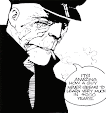
But there's more to Blue Murder than blood-spattered garage floors and suburban infidelity. DCI Lewis is, of course, a Working-Mother-Who-Has-to-Juggle-it-All – especially since her ex-hubby jumped on an EasyJet to Spain at the end of the previous series. So, we have a tacked-on subplot involving planning a birthday party for her son, who has fallen out with his best mate at school and benefits from a man-to-man chat with Janine's trusty deputy DI Richard Mayne (Ian Kelsey, pictured above).

Some Tory fella the other week got a bit of attention by saying bits of the UK were like The Wire, comparing Manchester to Baltimore. Blue Murder doesn't quite live up to that billing. It doesn't try to be as grim, gritty or edgy, but it maintains a serious atmosphere, anchored by the presence of Caroline Quentin and tempered by the trademark cheeky banter of the rest of her team.

It's a well-plotted and convincing murder mystery that provides enough false trails and possible suspects to keep the audience guessing, but then pulls a last-minute swerve (rather than a twist) to deliver an emotionally satisfying ending. Despite the unnecessary diversions into Janine's domestic situation, Blue Murder is solid TV cop fare; it's easy to see why it's got to a fifth series.

Picture: ITV

Monday, 7 September 2009

Away We Go, BFI

Away We Go (out on Sep 18, I think) is a fairly traditional Indiewood road movie, along the lines of Little Miss Sunshine or Sideways, directed by Sam Mendes from a script by Dave Eggers and Vendela Vida.

When thirty-somethings Burt (John Krasinski) and Verona (Maya Rudolph) find out they're expecting a kid, they realise they need to move out of their ramshackle house and find a more functional home in which to bring up their child.

They set off on a road trip to visit various friends and relatives and try out their cities for size. So, they drop in on Verona's uninhibited ex-boss, a trust-fund hippy childhood friend of Bert, Verona's sister and a pair of married college friends, before being summoned to Miami to help Burt's brother deal with his wife walking out on him.

Each of the encounters highlights a different facet of parenthood and the relationship between generations, fitting in with the classic road movie template of the characters' psychological journey taking precedence over their physical travels.

The journey eventually leads to the couple renegotiating the terms of their relationship and Verona starting to come to terms with the death of her parents in her early 20s. The revelation of the final destination in which they choose to live gives the film a simple (and mostly wordless) but surprisingly moving conclusion.

It's a fairly slight film, and its structure - obviously - means that it's a bit episodic; each of the 'chapters' is given an emphatic title card. Some of the characters are also a bit over-the-top or clearly designed to illustrate a point, but then the structure means that they don't outstay their welcome.

Away We Go isn't innovative or life-changing, but its leads give charming performances and it can sit alongside films like Broken Flowers, Transamerica and the two mentioned above as a worthwhile modern addition to the transformational road movie.

Interview with Eggers and Vida (Film in Focus)

Two-part essay on road movies by Sam North (hackwriters.com)

Friday, 4 September 2009

(500) Days of Summer plus Q&A, Barbican

NB: review contains spoilers

Last night we saw a preview of (500) Days of Summer at the Barbican, followed by a quick Q&A with director Marc Webb and co-writer Scott Neustadter. The film has been billed as a "post-modern rom-com"; greetings card writer and frustrated would-be architect Tom (Joseph Gordon-Levitt) falls for his boss's new assistant Summer (Zooey Deschanel), and we trace their relationship over the 500 days of the title.

However, while Tom throws himself whole-heartedly into the relationship, Summer remains a little aloof and unattainable, never quite committing fully. Their split is revealed early in the film, and rather than ending with them getting back together again, the 'happy ending' is Tom realising that had he put too much weight on their relationship and that he needs to look forward instead of back.

In terms of screenwriting techniques, the film is interesting in that it tosses naturalism out the window and uses a variety of narrative tricks to enliven the story. The most obvious of these is the non-linear structure. Using an onscreen ticker to identify which of the 500 days we're currently on, the film starts after the couple have split up, and then flips back and forth to show how their relationship developed and how Tom deals with its aftermath.

It also uses a Pushing Daisies-style narrator. The device is used sparingly, but once or twice it comes across as a slightly clumsy way of articulating what's going on in the characters' heads.

Other narrative flourishes include a split-screen comparison between Tom's expectations and the reality of a party he attends, and a musical sequence that depicts Tom's joyous state of mind the morning after he and Summer finally consumate their relationship.

However, the tone, style and structure are well established in the pre-title sequence, drawing the audience into the film's world so that the subsequent flights of narrative fancy don't come as a nasty shock.

The relationship between naturalism (still the predominant dramatic mode in the UK) and more overtly cinematic techniques is something that I think I've banged on about before. I generally love it when films draw attention to their artificial nature (Amelie and Annie Hall are examples that springs to mind), but as both a viewer and a writer it still feels a bit like a guilty pleasure - like it's somehow cheating to use narrative 'gimmicks'.

Anyway, that sounds like quite a dry dissection of what is a very enjoyable film. It might not quite be the new Annie Hall, as some slightly over-enthusiastic commentators have suggested, but it's a very engaging look at that time in your life when your first big relationship picks you up and gives you a good shake.

The Q&A after the screening was well led by film journo Charles Gant. Scott Neustadter said that the script was based on a relationship he had while living in London, and was initially an act of catharsis. However, the input of his co-writer Michael H Weber enabled him to gain a bit of objectivity on the material and convert his angry first draft into something more accessible and universal.

The writers were keen to draw attention to the gap between mainstream Matthew McConaughey-style rom-coms and the reality of how relationships actually tend to work. They also wanted to move beyond the stereotypes of how men are generally represented as emotionally illiterate in stuff like Judd Apartow's films.

In fact, they expressed a bit of surprise that the film is being marketed as a rom-com at all. They view it more as a coming-of-age story than a clash of the genders, as Tom moves from his initially idealistic view of Summer to a more mature appreciation of how relationships work.

Referring to the non-linear structure, they said that's how you tend to remember love affairs - your memory draws links between various episodes, such as trips to a particular location that took place under different circumstances. They spent a lot of time in development justifying each of the time-shifts in the script (although it becomes much more linear during the second half).

Following that structure allows the audience to analyse the relationship in the same way that Tom does, while also depicting how his perceptions and the way he remembers the relationship also changes, marking his growth from anger at their break-up to acceptance.

Interview with writers Scott Neustadter and Michael H Weber (HitFix)
Another interview with SN and MHW (CanMag)
Interview with director Marc Webb (Cinematical)
First draft screenplay (via Script Collector)

Friday, 14 August 2009

525,600 minutes of mantra-filled oompah


Well, inspired by Jez Friedman I just happened to glance earlier today at when I published my first post - and guess what?! It was a year ago to the day. So, I thought I'd better take a few moments off packing for a week's trip to the Edinburgh fringe to mark the occasion.

This time last year I'd just finished my MA at Bournemouth, and I have to admit that I haven't made quite as much progress with my screenwriting career as I would have wished. I took redundancy last August, so I've been establishing myself as a freelance writer and editor since, which has meant occasionally taking on too much work to allow for adequate screenwriting activity.

However, despite not promoting myself a great deal, I have been working on a couple of chunky projects that are quite a way ahead of anything I did before my MA (pilot script for drama series and new feature-length script), so there should be promising fruit from those particular shrubs within the next few months. I'm also waiting to hear back from a couple of agents who requested my main MA script after I sent out a few query letters.

I also (finally) picked up a copy of Adrian Mead's book How to Make it as a Screenwriter * this week, and was pleased to find that I'm already on the right road with some of the strategies he suggests for getting up that slippery ladder.

When we get back from Edinburgh I'm going to start knitting things together into a cohesive approach - including revisiting the stuff I wrote before doing my MA. I'd pretty much written it off, but some of it got quite a good reception, so hopefully I'll be able to attach the jump leads to its pink bits and give it a new lease of life.

So, that's Year One out of the way. I guess that trying to maintain the blog occasionally ate up time that could have been better used on more directly writing-related activity, but it's also encouraged me to try and form critical opinions more quickly about stuff I've seen.

Thanks to anyone who's commented or emailed over the past 12 months. My Year Two resolution - not to sound like such a tedious old stoat in my blog posts.

* If you haven't already bought and downloaded Adrian's book, you really should. It's a detailed and direct guide to what you need to know and what you need to have assembled in order to make a push at establishing yourself as a professional screenwriter. The testimonials on the page speak for themselves, but if you need any further convincing, the proceeds go to ChildLine.

Thursday, 6 August 2009

Budd Schulberg RIP


Yikes, now poor old Budd Schulberg has gone too, at the age of 95.
Mr Schulberg, the son of a movie executive born in New York, rose to fame in the 40’s and 50’s with a succession of award-winning books and screenplays, most notably his novels “What Makes Sammy Run” (1941) and “The Harder They Fall” (1947), and the film “A Face in the Crowd” (1957).

But it was “On the Waterfront” that Mr. Schulberg was best known for. The film, starring a young Marlon Brando and Eva Marie Saint, nearly swept the 1954 Academy Awards, earning eight Oscars, including one for Best Picture and another for Best Actor, which went to Mr. Brando. (NY Times)
Links:
Lengthy LA Times obituary
Creative Screenwriting: On the Waterfront Q&A (mp3)
On the Waterfront (Daily Script)

Wednesday, 5 August 2009

Blake Snyder RIP

Screenwriter and writing teacher Blake Snyder died yesterday after a sudden cardiac arrest. He was 57.

Like a lot of screenwriters, I've got a copy of Save the Cat on my shelf. I'm normally wary of structure gurus who say what you should be writing at any particular point of your script, but I gained a lot from his guidance on giving your idea a strong logline and emphasis on being able to explain clearly 'What it is'. His writing also gave off a real air of enthusiasm, encouragement and empowerment.

Condolences to his family and friends.

Monday, 3 August 2009

Single-Handed, ITV1

I haven't posted for a while because I wanted my 100th post to be a reflective State of the Tom Nation address, 12 months after completing my MA.

Anyway, that plan has now gone out the window, and here's a review of Single-Handed that I wrote for Orange.

Focusing more specifically on the writing, Barry Simner's script was an excellent whodunnit. He rolled out a number of credible suspects who all belonged in the story, without any flashing arrows or clumsy giveaways.

Then, having led us down one path, he skillfully and logically guided us into a more complex story altogether (although the segue into the 'back story' was a bit deus ex machina).

And while I thought the final terrible situation in which Driscoll found himself was a bit contrived, the emotional wallop of the drama and the suffocating lack of a way out for him justified it.

Links:
Interview in the Daily Telegraph
ITV press pack (Word doc)

Single-Handed is a Sunday night series about a young copper in a rural area. Think you've seen that one before? OK, but this one's set in Ireland, so surely we can expect charming rogues and a bit of after-hours diddley-diddley-dee by the pub's open fire?

Not so much. When you discover that it's produced by the same team that created the award-winning gritfest The Vice, you begin to get more of an idea of where this series of three self-contained feature-length episodes is really coming from.

'Natural Justice', the grim but gripping first episode, introduces Jack Driscoll (Owen McDonnell), a sergeant with the Irish police – the Gardai – who has returned to the remote area where he grew up after a period in Dublin. Isolated from his colleagues and back-up, he has to rely on his own judgement and resources to get the job done.

After a young Eastern European woman was found dead in an isolated caravan, it didn't take long for Driscoll's investigations to come up against a conspiracy of silence. (By the way, the actress who briefly played the unfortunate corpse shares a famous name, prompting The Guardian's listings to promise "a guest appearance by Martina Navratilova".)

Anyway, from what looked like an accidental death, things soon took on a more sinister atmosphere. Driscoll stumbled into a web of corruption that seemed to enmesh the whole community and had his father – and predecessor as local copper – at its heart. As he dug deeper, Jack uncovered dark deeds from the past and roused the opposition of powerful forces.

The programme was dominated by the stunning scenery of the remote Connemara region of County Galway, but the local tourist board are unlikely to use any of these shots in their next advertising campaign. While magnificent, the landscape is oppressive and unforgiving, matching the tone of the programme and highlighting the isolation of the small local community.

Single-Handed moves slowly and doesn't make for easy viewing, but the first episode rolled out its secrets in a masterly way, leading to a series of terrible discoveries and an impossible position for Driscoll. This is compelling stuff that puts aside the clichés to present a bleak but convincing picture of Irish rural life.